
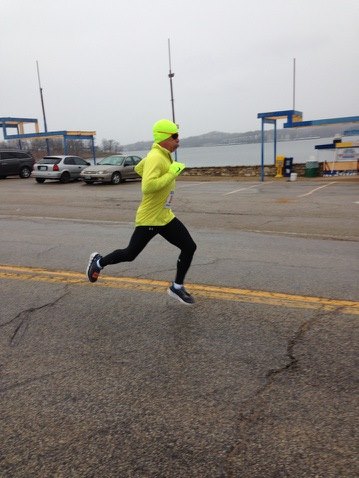
It’s no secret that exercise of any kind requires energy. Utilizing that energy to exert a force over a distance on your body results in work (Work = Force X Distance, or W=F(d), and that work translates into power (Power = Work/Time, or P=W/(t). These are simplified equations but serve to illustrate the basic concepts of work and power. An interesting result of these equations is to realize that the amount of work, and thus energy consumed by your body in the form of calories, is independent of time. So, moving your body a mile (with your feet, not on a bike) results in a calorie consumption of just over 100 Kcal (depending on your body weight and thus the amount of force needed this may be more or less – moving 200 pounds takes more force than moving 130 pound – but surprisingly not all that much more). So whether you run, walk, skip, or crawl a mile is a mile, and the force doesn’t change since your weight doesn’t change significantly, so the energy consumption is the same. What can change is how quickly you use up that 100+ kilocalories (Kcal). Walking at 4 mph uses 100+ Kcal in 15 minutes, whereas running at a 7 minute mile pace uses it in about half the time. That is a change in power, the same amount of work, but over a different time frame. So if you just want to use up calories it doesn’t matter how fast you move, its how far you move. Now carrying weight or working against gravity does add energy consumption, because it takes more force to climb steps (countering the force of gravity) than to move horizontally (push a box across the floor versus carry the box up the steps and you’ll see what I mean). Using a mechanical advantage device (i.e. a bicycle) allows you to use less force and therefore less energy consumption for that same distance (about a factor of one third traveling at 15 mph). What we improve with our training is the ability to exert that force over a distance in a shorter period of time, that is we get faster! So while walking a mile and running a mile use the same amount of energy, doing it with more power uses that energy over a shorter period of time, allowing you to do more work in a time frame.
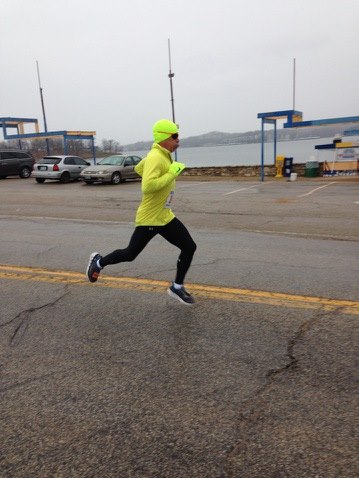
Getting stronger is the result of developing more power. Developing more power is the result of muscular adaptation to work. We do that by growing bigger muscle fibers with more contractility strength. That allows us to explode with our muscle contraction doing the work faster, that is, with more power. That is why just running or working at a comfortable pace will not get you faster, it may help endurance, but that is another topic entirely. To get faster you have to work harder in that same time period. Working harder in a fixed time frame leads to an adaptation of muscle that results in greater power, and thus faster times. And that is not a walk in the park (so to speak). We’re talking hills, interval training, speed work, sprint work, all those training modes that are, well, uncomfortable! So if you want that new PR (personal record) in that next 5K or half marathon, you’ve got to do that speed work. And that translates to tired, sore muscles, and aching lungs.
An important part of this adaptation is rest. After the harder work your muscle needs time to adapt, recover and rebuild. Don’t short change your hard work by failing to take time to recover. Without recovery and adaptation your muscle will actually deplete and injury or overuse injury becomes more likely.
Seems like there ought to be a spiritual application there, but that’s for another time. In the mean time: Get Up! Get Out! Get Going!

 dashingdisciple
Wow, Jim. No one has thrown that much physics at me since college. Nice post.
LikeLike